Sunday, November 29, 2009
Saturday, August 22, 2009
Dedicated to Peace: The World Headquarters of the Community of Christ
I prayed for peace in Tanzania. I prayed for successful peacemaking efforts around the world. I heard the organ pipes play and voices rise in song, “Let There Be Peace on Earth.” I was seated in a sanctuary where each day a different country is selected for reflection in the Daily Prayer for Peace. On this day, two pre-teen girls, accompanied by their mom, led the service in observation of the United Nations Youth Day. They read scripture, offered a prayer, sang the hymn, and became quiet to allow silent meditation. This brief experience happened in the emblem of peace for the world, the Temple Sanctuary of the Community of Christ in Independence, Missouri.
From the Campus RV Park in Independence where we parked the Prevost, the spire of the Temple rose high about the tree line shining in the August sun like a silver needle poking through a bright blue fabric. This architectural masterpiece is home to the World Headquarters of the Community of Christ, an international denomination with 250,000 members in more than 50 countries. Persons of all faiths are welcome to the Temple which was dedicated in 1994 to the “pursuit of peace, reconciliation, and healing of the spirit.”
The bright light in the Temple entrance showed off a row of international flags along the hallway and many colorful tapestries hanging from a balcony terrace. This initial brightness lasts only until you enter the doors leading to the Worshiper’s Path. These lights are dim here to allow time for reflection at each stop point before reaching the Sanctuary. Symbolic artwork along the Path includes a carved-glass entrance of a grove of trees and a granite sculpture of the return of the prodigal son. A rough-hewn cross proclaims the risen Christ. Ikebana-style floral arrangements symbolize heaven, humanity and earth. And, water flows over a granite pool representing the overflowing of God’s love. The light grows brighter at each station until finally, the grandeur of the Sanctuary overcomes you.
Most impressive is the Sanctuary’s spiral ceiling which rises 195 feet. Looking at it, I felt that if were to rise up to its peak, I’d surely float to heaven. That is exactly the effect the designers wanted “to focus on the Divine.” I felt certain that our prayers for peace that afternoon went direct to heaven.
After participating in the Daily Prayer for Peace, I joined a small tour of the Temple. I walked the Worshiper’s Path again, this time with narration explaining the significance of the art. In the sanctuary my guide warned, “You can become dizzy staring up to the pinnacle.” I had already learned this lesson.
He pointed out the 102-rank, 5,685-pipe organ in the Sanctuary that has pipes ranging in size from six inches to 32 feet. He invited us to attend one of the organ recitals beginning at 3 PM daily. He called attention to the award-winning stained glass window depicting the harvest of wheat and rice. He took our small group outside to the World Plaza where we walked on a brick inlaid map of the world. We sat in Meditation Chapel which overlooks a Japanese garden. There he answered questions about the Community of Christ and its founder Joseph Smith, Jr. Our group tour ended in the Library where some folks wanted to see the Doctrines and Covenants relating to the Church.
I was the only person who wanted to see the adjacent Auditorium. My guide graciously accommodated my interest in seeing more. He led me thorough an underground passageway connecting the Temple to the Auditorium.
The Auditorium features a 5,800-seat Conference Chamber with seating in-the-round beneath an expansive domed ceiling measuring 90 feet from the floor, 214 feet wide, and 168 feet long. The 111-rank organ here is among the largest free-standing organs in the United States with 6,500 pipes ranging from ¼ inch to 32 feet. In July 1948, President Harry S. Truman made history in the Auditorium by signing Executive Order 9981 to desegregate the United States armed forces. Now, the Auditorium functions as a religious, cultural and community center for the Kansas City region.
In addition to the Auditorium and Temple tour, there was still more to experience at the Community of Christ World Headquarters. A small museum houses 17 exhibits tracing the history of the Church from its origins in the 1820’s to its world missions today.
And, then back in the lobby, the tapestries themselves are particularly important. They represent “The Thread Project” – an international exhibition by Terry Helwig. The threads in each tapestry were pulled from the fabric of people’s everyday lives: threads celebrating births and marriage, threads from 9/11 families…over 50,000 threads gathered in 70 countries and seven continents. Then, Helwig enlisted weavers and textile artists worldwide to create the tapestries from these threads. The result of this seven year project is the creation of one World Cloth – a reminder that the human race is a global family of one, united by a common thread.
The Community of Christ World Headquarters merits a slow paced visit to absorb all it encompasses – architecture, art, history, meditation and prayer. When you go there, peace will be with you.
August 12, 2009
Community of Christ World Headquarters
1001 W. Walnut Street
Independence, MO 64050
816-833-1000
406 S. Pleasant Road
Independence, MO
816-254-1815
Sunday, August 02, 2009
Warm Welcome in Kansas City!
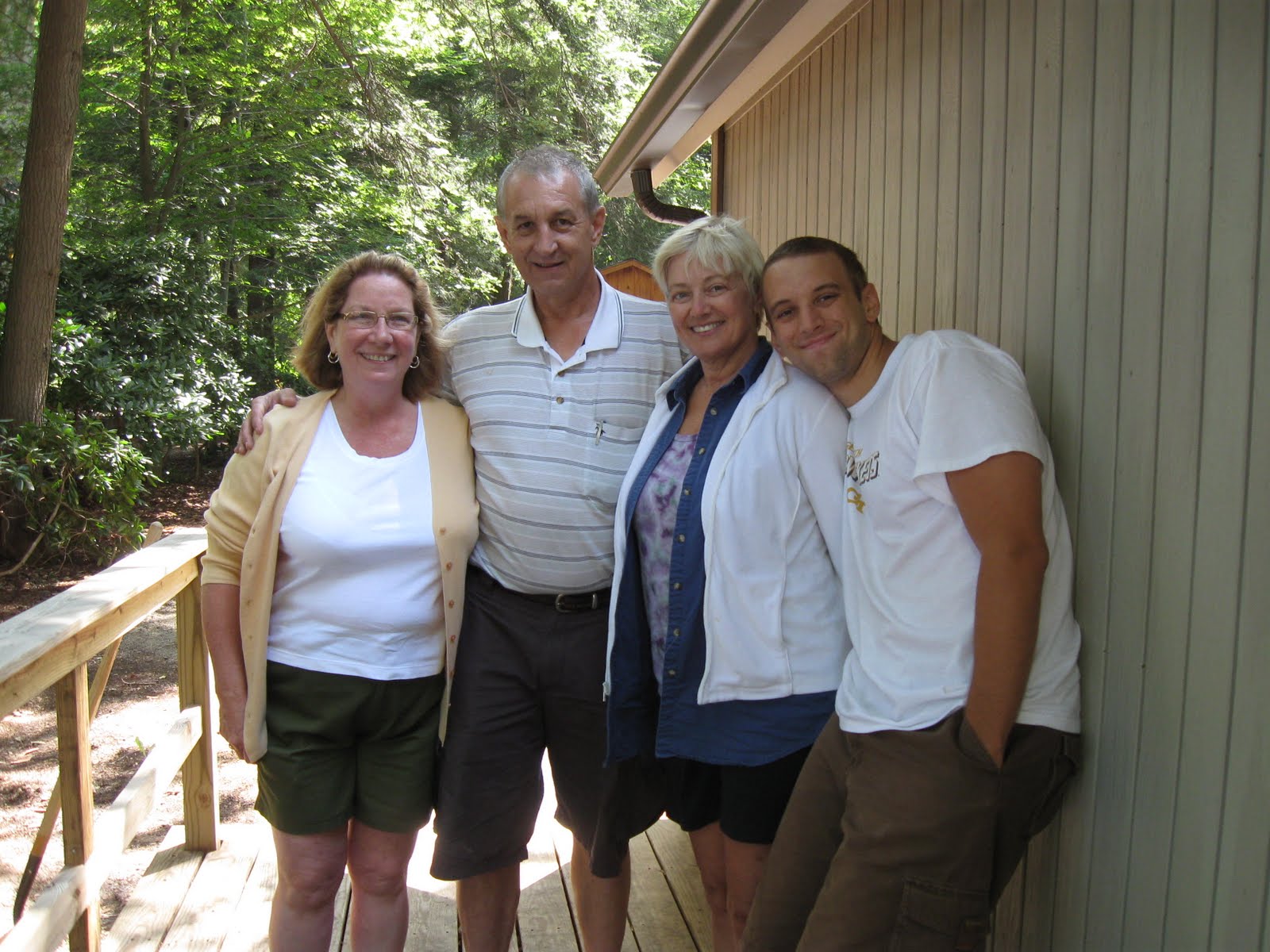
When a long journey ends, a warm welcome from family and friends can make you feel so good! And, that is exactly how we felt arriving in Kansas City. On Friday night, our “bus nut” friend Sean opened his house to us and gave us a place to park the coach. By Saturday morning, Suzie and Matt arrived at Sean’s house with hugs and happiness knowing that we’d be in Kansas City for awhile.
Ed and I have traveled over 28,000 miles during our two year road trip that began in September 2007. Four times Sean met us on the road – first in Marshall, Missouri ; then in Albany, New York; once in Pharr, Texas and finally in Fulton, Missouri. It only seems fitting that our final mile ended at his front door.
And, when we look at the map charting our travels, there’s a thick series of lines passing behind a photo of daughter Suzie. Many of our routes no matter what the destination went through Futon and St. Louis where Suzie has lived while studying at the university. I know she and her boyfriend Matt will be happy to have Mom close by – only four hours away, no more wondering “where’s Mom?”
To celebrate our coming to Kansas City, Sean grilled burgers and mushrooms stuffed with crab. Suzie mixed the seasonings for some dippy bread. And, I made a family favorite perogies and corn-on-the-cob too. What a feast!
We celebrated the ties that bind us. We celebrated a safe, extraordinary journey through the US and Canada. We celebrated my new job.
On September 1st, I begin a new career as the Director of Development and Marketing for a Kansas City non-profit organization. Sheffield Place empowers homeless mothers and their children to heal from their trauma and move toward self-sufficiency. When I am not out asking for money to fund this worthy program, I’ll be a tourist in my own town – Kansas City – and I will put the finishing touches on my book about our road trip.
Our journey maybe ending but more experiences will unfold. Expect the unexpected from me and more stories to entertain. This is a new beginning! Welcome to Kansas City!
Lewis & Clark vs. Ed & Patty
I nudged Ed with my elbow over and over as we watched the film about the Lewis and Clark expedition. So many points rang true to our own expedition in our Prevost coach “Dolly’s Pride.”
We had stopped at the Missouri River Basin Lewis & Clark Interpretive Trail & Visitor Center in Nebraska City, Nebraska. The Center sits on 79 acres of a wooded bluff overlooking the Missouri River, the very river navigated by Lewis and Clark over 200 years ago. We parked our 40-foot-long coach in the lot not far from the 55-foot-long, authentic replica of the keelboat used on this historic journey.
A three-story building houses the interactive exhibits and a theater. It was the film about the Corps of Discovery that reminded us most of our own Grand Tour of the US & Canada.
From 1804 to 1806, Lewis and Clark traveled under President Thomas Jefferson’s order to explore and find an inland route to the Pacific. We had no presidential directive, but our road trip ran the course of two years 2007 to 2009. They had brief and tense encounters with Indians. We encountered Indians. The encounters were brief but never tense. American Indians nowadays run the casinos. They gave us warm greetings, free places to park the RV, and eagerly shared stories about their culture. Lewis and Clark discovered that their keelboat was too large for navigation. On occasion our coach proved to be a bit too big on some winding narrow roads like the one to Winslow, Arkansas or when we encountered an old fashioned covered bridge.
Lewis and Clark traveled without maps and had to seek information and help along their journey. Our Wal-Mart Atlas served us well, but we too stopped to ask for information and help finding our way. We now have a Garmin. Lewis and Clark saw hoodoos, perhaps some of the same ones we saw out west. They saw elk, buffalo, pronghorn antelopes and prairie dogs. We did too. They complained about unpleasant insects – the mosquito. We consider them “unpleasant” as well. The expedition’s elk skin-bound journals recorded daily activities. This epic journal described culture and lifestyle. I used my Dell laptop for destination commentary, to write a blog “Did Someone Say RV Road Trip” www.glotours.blogspot.com and to comment on Facebook about our experiences.
Sometimes the Corps of Discovery rested for two days, sometimes for as long as two weeks. Ed and I also paused for days at a time, once we parked for nearly three months in Florence, Oregon so we could enjoy the Pacific coastline. And, when the expedition ended after 8,000 miles, Lewis and Clark returned to St. Louis for a hearty welcome. We are wrapping up our Grand Tour after 28,000 miles and came 200 miles shy of St. Louis. We received our hearty welcome in Kansas City, Missouri.
July 24, 2009
Missouri River Basin Lewis & Clark
Interpretive Trail & Visitor Center
100 Valmont Drive
Nebraska City, Nebraska 68410
402-874-9900
www.mrb-lewisandclarkcenter.org
For RVers, I recommend staying at
Victorian Acres RV Park & Campground
6591 Hwy. 2, Nebraska City, NE 68410
402-873-6866
Ice Cream & Willow Creek Campground: Reasons to Visit Le Mars, Iowa
I can give you two good reasons to visit Le Mars, Iowa – Blue Bunny Ice Cream and Willow Creek Campground!
Le Mars claimed the official title as “The Ice Cream Capital of the World” in October 1994. The town’s local Wells’ Dairy – the makers of Blue Bunny Ice Cream – produces over 120 million gallons of ice cream a year. That’s more ice cream produced by a single company in Le Mars than in any other city in the world!
When we arrived in Le Mars, I made a quick visit to the Ice Cream Capital of the World Visitor Center. When I found out they weren’t giving out samples, I headed straight to the 1920’s Blue Bunny Ice Cream Parlor next door. I tasted a few flavors before settling on one for my cone. I chose a vanilla ice cream laced with a ribbon of caramel and some chunky, crunchy pecans. It reminded me of my Baskin- Robbins favorite Pralines n’ Cream only richer.
Did my Blue Bunny treat deserve the raves I heard preceding my visit? Yes, but I would venture to bet that these Blue Bunny loyalists have never tried what I still consider to be the best ice cream. The Creamery at Penn State University in College Station, Pennsylvania remains #1 in my ranking. Bruster’s Real Ice Cream Shops are my favorite neighborhood ice cream parlors especially when they are serving Chocolate Raspberry Truffle. I am loyal to Baskin-Robbins for an occasional treat too since I scooped their ice cream for extra cash in college. On occasion, just give me a spoon and you’ll catch me eating some Ben & Jerry’s ice cream right out of the grocery store pint size container. And, when in Texas I learned that Texans love their Blue Bell Ice Cream just like the folks in Le Mars love their Blue Bunny. On a hot day, just about any ice cream will satisfy me.
Just like the ice cream, Willow Creek Campground gave me a good feeling. This Le Mars Municipal Park offered trees to shade our coach on the sunny days and a scenic place to barbecue our dinner. We could have filled several days here riding the bike trails, walking the paths, swimming in the pond, fishing, or testing our golf swing. Our two day stop flew by and we were on the road before we had time to appreciate these amenities around us. For a Municipal Park, Willow Creek exceeded my expectations. RVers passing through should consider this affordable location.
July 21 - 23, 2009
Gambling & Grotto: An Odd Mix at the Grotto of the Redemption in West Bend, Iowa
“So you are on the sinners and saints tour,” laughed Rhonda. You could draw that conclusion. While passing through Iowa, we parked the coach for two nights at the Wild Rose Casino. From the Casino, we drove our Toyota to visit the Grotto of the Redemption. Gambling and a Grotto – what an odd mix!
It happened because of a mere mention of my agate hunting adventure along Lake Superior. This conversation with a manager of the Wild Rose Casino prompted her to recommend a nearby attraction. “If you enjoy agates or stones in general, you must visit the Grotto of the Redemption.” We had seen the roadside sign along Highway 18 earlier and passed it. Now on this hot summer afternoon, I reconsidered. The temperature in the coach was rising and my casino budget was dwindling. The time seemed right for an outing. My expectations of this attraction were low. Little did I know that visiting the Grotto would leave me feeling like I hit the “jackpot”!
Often called the “Eighth Wonder of the World” and a “Miracle in Stone, the Grotto of the Redemption spans a full city block in West Bend, Iowa. It is the largest religiously inspired grotto in the world. The Grotto is actually a composite of nine separate Grottos; each portrays a scene spanning the life of Jesus from His birth to His resurrection. The highest point of the Grotto rises forty feet. This mountain commemorates the 13th Station of the Cross – Jesus is taken down from the cross. His limp body lays cradled in Mary’s arms in a sculpture patterned after Michelangelo’s famous Pieta. This is just one of the many Italian Mosaic and Carrara marble statues that adorn sacred place.
More than its size, more than its lifelike statues of the Holy Family and other Biblical figures like Adam & Eve, Moses, and heavenly angels, the minerals and stones used to construct the Grotto make it a geological wonder. One man – Father Paul Dobberstein (1872 – 1954) started construction of the Grotto in 1912 to fulfill a promise he made to God. For 42 years, Father Dobberstein labored setting the rocks and gems into concrete.
According to Rhonda Miller, Director of the Grotto, Father used materials considered to be “junk” at a time. Farmers and landowners were happy to have Father haul the stuff away. That “junk” represents a vast collection of minerals and stones – petrified wood, stalactite and stalagmite, malachite, jasper, quartz crystals, sea shells, and other gems invaluable today. An entry on Wikepedia sets the value of the Grotto gems at $4.3 million. In reaction to that number, Rhonda commented, “Bill Gates couldn’t build it. We can’t rebuild it. The materials aren’t available. The Grotto is priceless.”
The Grotto is listed on the National Register of Historic Places. Its geological value is world renown for rock hounds and artists. Architects study its construction. The non-religious visitors find it a “peaceful place.” The Faithful visitors move closer to Christ after they experience the Grotto. Rhonda Miller says she annual visitation to range between 25,000 – 30,000 people. Guided tours are available May through October, and anytime by appointment. I caught part of a tour but spent most of my time looking at the dazzling minerals and stones, each one unique, each one crafted by the hand of God.
In this sinners and saints tour, I took a gamble visiting the Grotto. It paid off big time!
July 19, 2009
Grotto of the Redemption
300 N. Broadway
West Bend, Iowa 50597
800-868-3641
RVers should note that the Grotto has a
campground with 80 sites available for RVs.
Electrical hookups are at each site.
There is an RV dump station available too.
Christmas Grotto in West Bend, Iowa
When experiencing the Grotto of the Redemption, one could easily overlook the adjacent church. Inside Sts. Peter and Paul Catholic Church are two things you must see during a visit.
The Christmas Chapel is constructed of ornamental rocks and gems. It contains a Brazilian amethyst that weighs over 300 pounds. This nativity scene is considered to be one of Father Paul Dobberstein’s finest works. He completed the Christmas Chapel in 1927 using materials he considered too delicate to withstand conditions that would affect them if placed in the outdoor grottos.
A wooden altar stands 22-feet high in the sanctuary. Hand-carved out of bird’s-eye maple, this altar won first place at Chicago’s World Fair in 1893.
After admiring the Christmas Chapel and altar, you can light a candle and spend some time in quiet mediation inside this peaceful church.
July 19, 2009
Grotto of the Redemption
300 N. Broadway
West Bend, Iowa 50597
800-868-3641
Must Be Iowa!
I simply sent a photo from my Verizon phone to the kids and they immediately knew where Ed and I had arrived with the Prevost. The shot of the green corn field gave away our location.
“Iowa!” came confirming the text messages. “Makes me shudder!” I replied.
Both Chris and Suzie remember our family trip in our first MCI bus conversion motorhome. Some ten years ago, we traveled to Ames, Iowa to attend a Family Motor Coaching Association Rally. This is a trip we will never forget and can only now laugh about the experience.
We were so new to the world of RVing that we didn’t have a tow dolly. No problem…Chris at 16-years-old and eager to drive would follow “Dolly’s Pride” (the MCI) in “Zippy” (the Honda Acura). We’d have a run about car and Chris could feel the thrill of his first road trip. We communicated by CB coach-to-car cruising west from Pittsburgh along Interstate 70. Miles flew by and our caravan held tight until we approached Indianapolis. Chris radioed information to Ed about turning on the beltway around the city. Ed confirmed then promptly missed the turn.
We heard Chris ask, “Where’d you go?” Then, we lost radio contact with him.
Immediately, I began to worry about my son – only 16-years-old, with a brand new driver’s license, somewhere off in Indianapolis. Surprisingly, Suzie reacted to this situation. The brother she claimed to find annoying and acknowledged frequently with a hateful sneer was her new best friend. “We lost my brother!” She cried big tears. “I love him. We need to get him back,” she pleaded. Her tears made me cry too as I hugged her tight.
What seemed like an eternity later, Ed turned the bus around and retraced the route to the turn where we lost Chris. We used the CB to call out to him and finally, got his reply. We found him sitting in “Zippy” calmly waiting for us at the roadside rest area.
Full hook-ups were not an option for us when our family caravan arrived at the Ames rally. We ended up boondocked in the parking lot of a veterinary school. Running the generator gave us power to run the air conditioning. This helped cool the coach a bit; but when we shut down the generator, the inside temperature climbed to suffocating temperatures. No breeze blew through the windows. In desperation, I left my bed, crawled over the kids sleeping on the front couch, and opened the coach door to feel the night air. I crouched there trying to get cool, then eventually laid down on the cold granite floor with my head practically sticking out the door. When the kids discovered me in the morning, they felt sure I’d suffered a heart attack or been murdered in the night. Ed didn’t see this spectacle of his wife laying on the floor with her head and arms dangling out the door. Iowa in July is hot as hell!
The rally exhibit area provided some relief from the heat by day; but it could not relieve the boredom of two kids – 16 and 11 years old. With some hesitation, we gave the kids permission to drive “Zippy” around Ames to see if they could find something amusing to do for the day. When they met us later, we expected to hear about their adventure. Instead they retraced their route on a map showing us the roads they traveled. All the roads were lined with corn and every road ended at a corn field. “We saw corn, corn and more corn!”
Now, we all just need a photo of a corn field to trigger the memory of this 1999 Chevy Chase –style “family vacation” and know with certainty “Mom’s in Iowa!”
Waiting on the Train in Trempealeau: SP 4449 Makes a Rare Appearance
Usually if you are waiting on a train, you plan to get aboard. No so for the many people who gathered along the tracks in Trempealeau. They waited in anticipation. They followed tweets on Twitter. They clung to cell phones calling friends spread geographically along the track. Some stood, Ed sat. All hoped to get a photo, a video, a glimpse of the world famous steam engine SP 4449.
The Southern Pacific Daylight no. 4449, manufactured in 1941, was among the last mainline steam locomotives to be built. Coming out of retirement, SP 4449 is traveling across America on an Amtrak sponsored trip hauling passengers on a rare excursion.
Just by luck, Ed and I stopped in Trempealeau, Wisconsin on the morning of Saturday, July 18th as we traveled along The Great River Road. A train enthusiast told us about engine SP 4449. He’d driven for more than 2-hours from his home to be trackside. With each rumble of the tracks, he and others jumped with excitement. These false-alarms were diesel engines hauling industrial cars on the tracks across the Mississippi River.
More waiting. Someone got a call! “The train just breezed through Cochrane,” he announced to anyone wanting a progress report. Serious calculations began – time and distance – guesses about arrival time rumored through the waiting crowd.
Soon we could felt the vibration of the ground and glimpsed the puff of steam. The engine approached without slowing at all. Someone with a stopwatch clocked 62 mph. SP 4449 thundered past then faded as quickly as it appeared.
July 18, 2009
Boondocking in the Village of Cochrane
The population of 435 people in the Village of Cochrane, Wisconsin increased by two recently. Ed and I stopped there for a night as we traveled on Wisconsin State Road 35, otherwise known as the “Great River Road.”
We found a church parking lot that wasn’t quite big enough for our 40-foot long Prevost “Dolly’s Pride.” For the moment, we parked there anyway just to walk around town and find a more appropriate spot. We didn’t walk more than a few feet. A woman got out of her compact car to take a photo of the church so we asked her about where we might boondock for the night.
She knew the community well. She grew up here. This had been where she went to church. Across the street, she fondly remembered as the home of her aunt who ran the town gas station and lived upstairs above the pumps. As she reminisced, we noticed her adolescent grandson squirming in the car. He had accompanied her back “home” so she could show him the place of his family roots. She said we could follow her to the community park, a place where “nobody will mind you staying the night.”
Nobody minded that “Dolly’s Pride” took up all the parking spaces in the small lot across from the village swimming pool. Nobody minded that the two of us dined lakeside in a picnic pavilion with seating for 60. Nobody minded that we feed the ducks waddling under the drooping branches of the ancient trees. And, nobody minded that we pressed our faces to the fence and watched a herd of reindeer graze.
July 16, 2009
The Best Water - Ashland's Artesian Water
When the local water tastes bad, I tend to drink beer. If I buy the same brand, the brew tastes consistent and refreshing. Not so with water! Water – simple H2O – can taste very different as I have learned while on our “RV Road Trip.” Some water reeks of chlorine, some of lime. One time the water looked yellow. It smelt bad so I drank only bottled water from a commercial filtered dispenser that cost me 25-cents to fill a gallon jug. Although our coach has a water filtration system, if you start with bad tasting water, no amount of filtering can make it taste anything but nasty.
Only once have I found water that tastes pure and good. This water runs free from an Artesian Well in Wisconsin. Naturally purified, the water does not need pumping. It flows upward from the groundwater through an open pipe. Anyone can fill a glass or jugs, just wait your turn outside the tiny wooden shack at the City of Ashland’s Malowski Beach. A roadside stop for a quick drink was all I needed to declare this water the best I ever tasted during our travels. It’s the best I tasted in a lifetime!
For ten days, we camped near Ashland and I made several trips to the Artesian Well for refills. We even made one last stop there on our way out of town and savored every last drop!
Wisconsin Logging Site: Not Your Ordinary Wood Pile
If you pop your head in the unlocked office door, if you wave to the security camera, and holler “Hello” loudly as you walk around the property and no one responds, are you trespassing? I’d say “No.” So we continued without escort to venture closer and closer to the stack of logs Ed and I noticed during our drive on a country road outside Ashland, Wisconsin.
This was no ordinary wood pile! The logs formed a mountain showing off the concentric circles – the growth rings – of each cut tree. Logs wedged on the end of the stack kept the mountain from cascading in a disastrous roll sure to crush anything in the path.
Train tracks ran parallel to the log mountain. And, more piles across the tracks gave the illusion of a landscape of rolling hills.
Ed and I wandered around this industrial site carefully. And, even though Ed loves big logs for our campfires, the massive size of these cuts caused him to pause. He didn’t even consider grabbing one as a souvenir for fear of causing an avalanche.
As travelers, we stop at places like this because it gives us a glimpse of the economic engine behind the façade of a town’s painted murals, quaint specialty shops, and antiseptic visitor centers. It builds an appreciation for the raw materials before they go to market to become a household product. And, it reminds us of the hard working, extraordinary people found in each community we visit.
July 15, 2009
An American Indian Cemetary
Wind chimes jingled as I walked reverently through the cemetery. For some only simple wooden crosses marked the grave. Other grave decorations were much more elaborate. Great carved wooded eagles with wings rising up and bears standing on hind legs set where traditional headstones might rest. White linked chains fenced the perimeter of some burial sites. A cast iron gateway created a courtyard for one plot. Sun faded pink, yellow, blue and white silk flowers honored many of the dead giving the flat field splashes of color. American flags waved for the veterans. And, statues of elves, parrots, Mickey& Minnie Mouse, and a Dalmatian made me wonder about the significance of their presence.
In an older section of the cemetery, weathered headstones leaned at angles. Many of these people laid to rest here had died over 100-years ago: John 1873 -1904; Our Darling 1905 – 1906; Mary Leamux died 1899 21-years; and Chief Antoine Cloud 1842 - 1910. Giant pines and a huge stone cross cast quiet shadows over the graves. No wind chimes rang here.
These cemeteries are located in Odanah, Wisconsin
on the reservation of the Bad River Band of Lake Superior Tribe of
the Chippewa Indians.
July 15, 2009
Northern Great Lakes Visitor's Center
The Northern Great Lakes Visitor Center near Ashland, Wisconsin is a place that you can return to again and again. Admission is free. Go alone or take the family. There is something for everyone – exhibits, films, a trail, and a special outside kid’s area. I visited the Center twice during our stay on Lake Superior.
When I first stopped at the Visitor Center, I arrived too close to the 5 o’clock closing time to spend more than 45-minutes there. I approached my short visit this way: up high and descending to the exhibits.
From the top of the Center’s five-story observation tower, I enjoyed the panoramic view of the Chequamegon Bay from the outside catwalk. The landscape was flat with farm fields, grassland, wooded acres, and a pond where cattails thrived. In the far distance, I could see the outline of the Ashland ore dock jutting into Lake Superior. A strong cold wind gusting forced me back inside the window enclosed observatory where I could study the displays explaining the landscape around me.
On the next level, I found an exhibit about winter life on Lake Superior. The more I read, the more I wanted to plan a return trip in January or February. That’s when part of the Lake freezes and the ferry is docked. Residents on the island communities travel on ice roads over the frozen lake to get to the mainland. Some use snowmobiles; others actually drive their vehicles on the ice road. How cool is that! An authentic sign on display warns: “Ice Road Travel At Your Own Risk.”
Historical photography hangs on the walls outside the Wisconsin Historical Society Archive & Research Area on the second floor. This pictorial exhibit documents the families and workers who settled the region in the 1930’s and 1940’s. As I browsed these black and white photos, I overheard a woman discussing the exhibit. She had intimate knowledge of the people and places. She pointed to the faces in the photos calling them “Dad,” “Aunt,” and “Uncle” while she talked to her lady friend about fond memories of summer passed on Lake Superior.
I had just enough time to stroll through some of the first floor exhibits before closing time. I enjoyed the mining display the best. I could peer through a dark tunnel where lanterns barely gave light. A rail car waited to be loaded with the ore. A box detonator with the “T”- shaped handle tempted me to push down. When I gave in to curiosity, I mimicked the old time movies and used a two-handed grip to push down. Sure enough an explosion rocked the tunnel – the boom echoed, lights flickered and a simulated explosion clouded the tunnel view! I waited for the exhibit to re-set, and then did it again! This time more lights flickered, it was the Ranger – not me – grabbing visitor’s attention. Closing time would be in a few minutes.
Several days later when I returned to the Northern Great Lakes Visitor Center, I took a new approach. There are many films available to view in the theater. With no rigid schedule, visitors just pick a film and on-demand the Ranger will start the show. I selected one about how Native American Indians in the region are working to preserve and practice their historic language. Other visitors slipped in and out of the theater, but I stayed for the entire length of the film learning much about this little known topic.
I needed to stretch my legs after that 45-minute film so I walked outdoors to the boardwalk trail. This ¾ mile trail is called the Transition Trail. It begins surrounded by tall waving grasses, an invasive non-native species called Eurasian Reed Canary Grass. Because the grass offers little food or protection, few birds or animals are seen along the trail. The trail winds from waist high grass through a grove of towering trees. Some pines have lost their anchor in the ground and lean into other trees. When they swayed in the wind, their bark creaked like an old board in Grandma’s hardwood floor. Where sunlight broke through the trees, wild flowers grew. And here and there, budding blackberry bushes showed signs that fruit would ripen in a few months. Benches long the boardwalk trail invited me to sit a bit but not for exertion. The trial was easy and flat. I sat just to enjoy the music of the trees and wind.
A “Y” in the trial presented a choice: go left past the cattails in the pond back to the Visitor Center or go right to the Nature Discovery Area. I chose right. This “Let’s Go Outside” area is designed for kids. Colorful rubber boots of all children’s sizes give parents no excuse for stopping the kids from playing in the tiny shallow pond. At the next outside station, they can crawl through a manmade hut that replicates a beaver dam. In another area, there are nets to catch butterflies. One play area has kid-size pieces of tree branches and rocks to handle for close inspection. And finally, a timeless sand box invites kids to enjoy themselves with pint-sized trucks, buckets and shovels.
Something for all? Oh yes! And, it’s fun for free at the Northern Great Lakes Visitor Center.
July 8 & 15, 2009
Northern Great Lakes Visitor Center
2.5 Miles West of Ashland, Wisconsin
29270 County Highway G
715-685-9983
Friday, July 17, 2009
Inside St. Mary's Church in Odanah, Wisconsin
Ask a child to draw a church. The likely result will be a rectangular shaped building with a steeple topped with a cross. The overly simplistic drawing would resemble the many churches Ed and I passed during our 2007 -2009 Grand Tour of the US & Canada. The drawing would probably look something like St. Mary’s Catholic Church in Odanah.
We found St. Mary’s Church by following a directional sign off Wisconsin Hwy. 2 in Odanah. On our first visit, we could only walk around the outside admiring the white church with Wedgewood blue trim. We wondered about the cultural significance of the statue of a young Indian woman encased in a triangular shrine that decorated the lawn. I made a note to attend the Saturday Mass at 4 PM.
At 4:50 PM on Saturday, July 11th, Ed and I approached the Hwy. 2 directional sign returning from a lakeshore drive. “We missed Mass,” I reminded myself aloud. “But, let’s head over to St. Mary’s anyway. Maybe the Church door is still unlocked.”
We found the door wide open. The soft sound of conversations confirmed that Mass had ended. We could smell the aroma of seasoned food and fried chicken. “Welcome! Welcome! Let us fix you a plate of food.” A woman, who introduced herself as the President of the Parish Council, embraced me in a hug and led me by the hand to a buffet on narrow tables set against the back of the last church pew. I allowed her to make a plate for me even though I’d had filled up on pizza only a short time ago. The traditional Indian corn chowder tasted delicious. I saw Ed smacking his lips as he munched on some chicken and talked to the pastor, a Franciscan Friar named Father Paul. The parish potluck celebrated the Feast of Blessed Kateri Tekakwitha, the Indian in the outdoor shrine.
Pope Pius XII venerated Kateri in 1943 and Pope John Paul II beatified her in 1980. This Parish and others pray for her canonization. Kateri was born in 1656, the daughter of a Christian Algonquian mother and a non-Christian Mohawk Chief. At age four, she suffered from smallpox, a disease that left her eyesight weakened and her face scarred. As a teenager, she converted to the Catholic Faith. She suffered for her faith because her tribe did not accept her decision to be baptized. She left her village called Ossernemom, near the town of Auriesville, New York to live in a new Christian colony of Indians near Montreal in Canada. Kateri dedicated her life to prayer, penitential practices, and caring for the ill and aged. On April 17, 1680, when Kateri died, two Jesuits and many Indians with her witnessed a miracle. Within 15 minutes of her death, the ugly scars on her face suddenly disappeared. She became known as Blessed Kateri Tekakwitha, “Lilly of the Mohawks.”
There is a second shrine to Kateri within St. Mary’s Church. Her statue is surrounded by vases of flowers. A candle flickers in a tall red votive glass. On her head is a beaded crown bearing the name “Kateri” and around her neck is a beaded necklace. The women of the parish made beading for the statue. More displays of this craft decorate the altar with intricate detail of flowers, a heart, and even a turtle.
For the Feast another statue of Kateri, sat among some green plants, candles and some special offerings. A table near this display held ivory crosses decorated with a small yellow lily. Father Paul wanted each parishioner to have a cross to remember this day honoring “Lilly of the Mohawks.” I also received one as a gift to keep as a memento of this special day. It is the day when I missed Mass but found a symbol of cultural heritage, worship, friendship and love in that little rectangular church with a steeple and a cross on top.
July 11, 2009